
Why Pockets Are the Hardest Place to Match Stripes on a Suit
Plan stripe alignment at the marker, pockets, lapels and sleeves and verify the result in the finished suit.
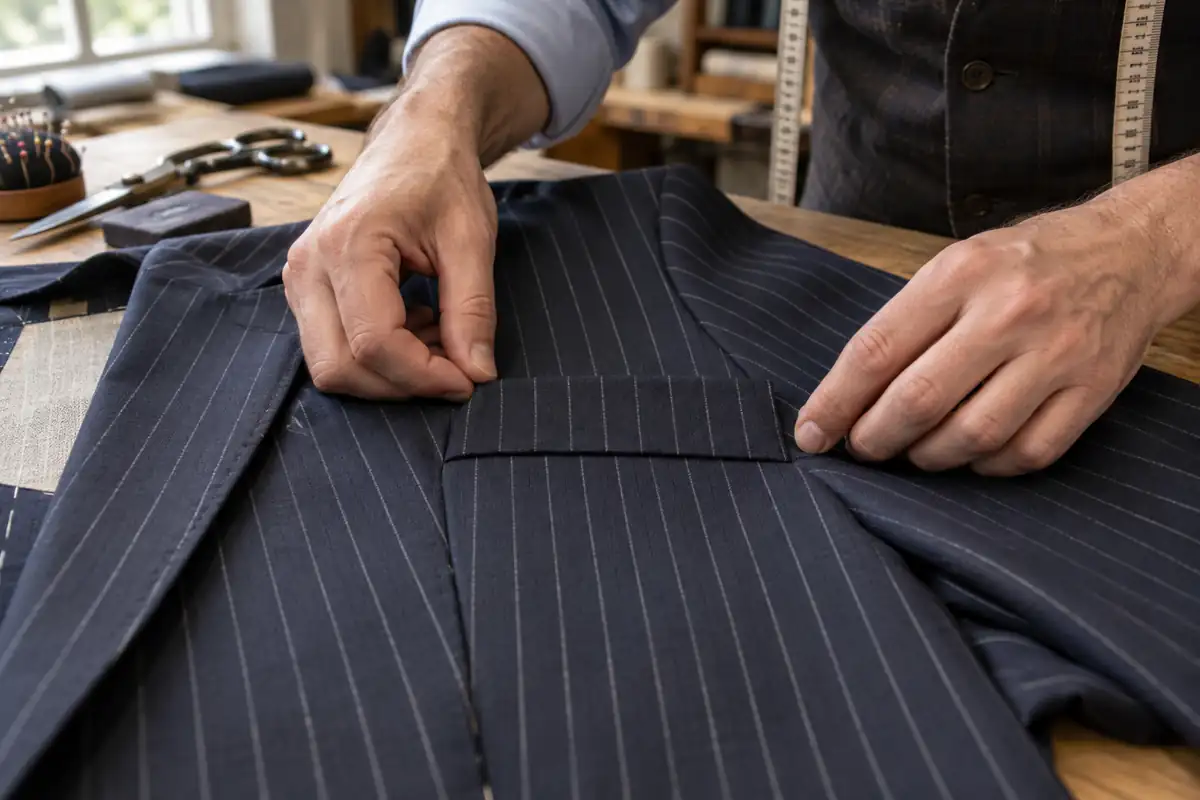
Stripes expose small alignment errors
Fronts, pockets, lapels and sleeves can show a shift of only a few millimeters. Matching a stripe generally takes more planning than the equivalent solid.
Start matching in the marker
Place a reference stripe on the center, front or key line. Mirror left and right pieces as needed and allow for greater fabric consumption.
Continue the jacket stripe across the flap
The flap should continue the background as closely as practical when closed and look neat when lifted. Changing the pocket angle moves the stripe intersections.
Check the lapel in its rolled position
A match on the table may look different at the chest. Assess visual continuity along the finished roll.
Prioritize visible areas around sleeves
The curved sleeve cap requires ease, so every stripe cannot match all the way round. Prioritize the areas visible from the front.
Control shifting during sewing
Accurate pieces can still slip when layers feed unevenly. Align key points before machine sewing.
Set alignment priorities
Marker planning, roll and sewing tension can each move a stripe. Specify which joins matter most for the finished garment.
Look at the suit off the cutting table
Inspect the whole jacket, then close-up workmanship, then the lines while it is being worn and moved in.
Aim for a natural visual continuation
Good matching uses material and three-dimensional shape intelligently rather than requiring impossible continuity at every seam.
Why Suit Lapels Roll Naturally: The Hidden Structure →